













Older Australians in regional, rural and remote communities wait weeks for clinical services city residents take for granted. And after the Royal Commission’s 24/7 registered nurse mandate, the workforce maths stopped adding up for rural providers.
McLean Care’s answer is iAgeHealth: a virtual hub of clinicians — registered nurses, nurse practitioners, physiotherapists, occupational therapists, dietitians, Aboriginal Health Practitioners — delivering real-time care to the bedside from anywhere in Australia.
A vision like that lives or dies on its operational engine. Every referral has to reach the right clinician, in the right discipline, with the right context, at the right time — around the clock, across time zones, across dozens of facilities.
That engine is Kiln.
The challenge
Bring the clinic to the bedside — anywhere in Australia.
A resident in the Northern Tablelands could wait a fortnight to see a physiotherapist after a fall. The 24/7 registered nurse mandate that followed the Royal Commission made traditional staffing models impossible for rural and remote providers — the clinicians simply aren’t there to hire.
iAgeHealth flips the model: instead of moving clinicians to the regions, it moves the care. That takes more than video calls. It takes an operational engine that can route every referral, roster a national virtual workforce and keep a shared clinical picture of every client — reliably, auditably, at scale. Antero built that engine on Kiln, our workflow and AI orchestration platform, purpose-designed for regulated, high-stakes service delivery.
What we built
We were there from the beginning — working closely with McLean Care and specialists from Deakin University through the earliest prototypes, the two-year testing and development phase, and on through national launch and commercial scale. Kiln runs the machinery behind the care:

Referral routing & triage
Incoming referrals are allocated across clinical specialities — wound care, diabetes management, dementia care — and allied health disciplines, matched to clinician availability and scope of practice.

Continuity by design
A small, consistent group of virtual clinicians is allocated to each facility and home care service — so older Australians and staff build relationships with the same clinicians over time, replicating the continuity of face-to-face care.

Rostered virtual workforce
Dedicated 24/7 rosters ensure every participating facility always has clinical cover — across states, across time zones, every shift of the year.

Multidisciplinary case coordination
A single shared view of each client across nursing, allied health and diagnostics, so care stays continuous rather than episodic.

Clinical tool integration
Third-party assessment tools such as PainChek plug directly into the workflow at the point of care — no swivel-chair, no re-keying.

Audit-grade records
Every action logged, attributable and explainable — built for a sector answering to regulators and Royal Commissions.
All of it designed for users who aren’t tech savvy. The technology disappears; the care shows up.
“Virtual care is in most cases a very close substitute for in-room care.”
McLean Care submission to the Inspector-General of Aged Care, 2025
The outcomes
24 hours
Physiotherapy assessment within 24 hours of referral — down from waits of two weeks or more
24/7
Allied health delivered around the clock into remote NT Indigenous communities through the Roper Gulf Regional Council partnership
9/10 → 2/10
Documented client pain scores reduced from 9/10 to 2/10 over three months of virtual care
First 6 months
Significant reductions in avoidable hospital admissions within the first six months of commercial availability
1,000 people
Live across 10 residential aged care facilities plus home and community care settings in NSW, QLD and NT — supporting up to 1,000 older people
670 km
Remote First Nations care on country — virtual multidisciplinary care, including an Aboriginal Health Practitioner, for a client 670km from the nearest commercial centre, avoiding a two-year wait and ~$10,000 in fly-in costs. Pain down from 9/10 to 3/10; independent mobility restored
Alongside the numbers: improved early recognition of clinical deterioration across participating facilities, and a Highly Commended at the 2024 Future of Ageing Awards.
“iAgeHealth is not just an Australian clinical workforce solution; it’s a global solution.”

Sue Thomson — CEO, McLean Care
Why it matters
iAgeHealth proves the model: complex, multidisciplinary, regulated care, delivered virtually into the hardest-to-reach communities in the country — and Kiln is the platform that makes it run.
The same architecture adapts to any domain where fragmented services need joining up: cancer care, disability, chronic disease, community health. Where there’s a workforce shortage and a workflow problem, the engine already exists.
Built by Antero. Powered by Kiln. Launched in 2023 Australia Wide.

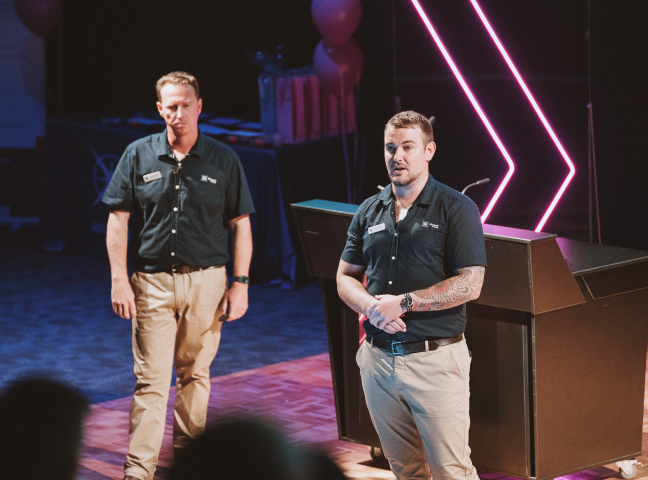
Procast turns Binnacle Training’s annual VET in Schools Conference (ViSC) into a hybrid live + stream event
End-to-end Digital Event Software, Production & Broadcasting